How your speaking voice affects your singing. And how to improve both

When a singer has issues with their singing voice, it can sometimes be traced to their speaking voice – because the mechanics of producing sound, and language, are similar.
Some singers may have a speaking habit that’s unhelpful to singing. They may unconsciously constrict their throat and larynx to achieve a deeper tonal colour, or have a habit of lowering their soft palate and speaking with nasality.
That’s not to say you must have a perfectly ringing voice when you speak or sing. Your voice, after all, is your signature. Some performers accentuate their rough or breathy spoken voice as their signature or persona. Australian comedian Dave Hughes, for example, uses his nasal, squeaky sound with accentuated diphthongs, in his act.
However, singing requires more intensive use – and stamina – of your vocal apparatus than speech does. This is why singers need to learn to use their voice in a healthy, sustainable way.
How working on your speaking voice benefits your singing
Like singing, healthy speech begins with a relaxed open throat space in the mouth, and breathing that coordinates with your lower torso, rather than a shallow upper chest breath. The appropriate articulation needed for singing is also the goal of easy, clear speech.
That’s why before each singing lesson, I engage a singer in a little chat before vocal exercises, to hear the quality of their speaking voice for that day. This gives me insight into how tired they may be, whether they have over used their voice, or if something else is affecting their speech, which will impact their singing.
When someone has speech qualities that concern me, I will suggest they see a speech pathologist or therapist for a few sessions to assist their speaking, enhance their singing training and rule out any pathology.
While I’m not a trained speech therapist, I worked with one for two years, to achieve more forward resonance in my sound, which benefited my own singing and speech. I also developed a keen ear for how sounds are shaped, articulated and moderated to achieve the tonal and stylistic quality a song and singer want to achieve. Now I use that knowledge when I teach singing, and I’ll often ‘super set’ or match singing exercises with speech exercises.

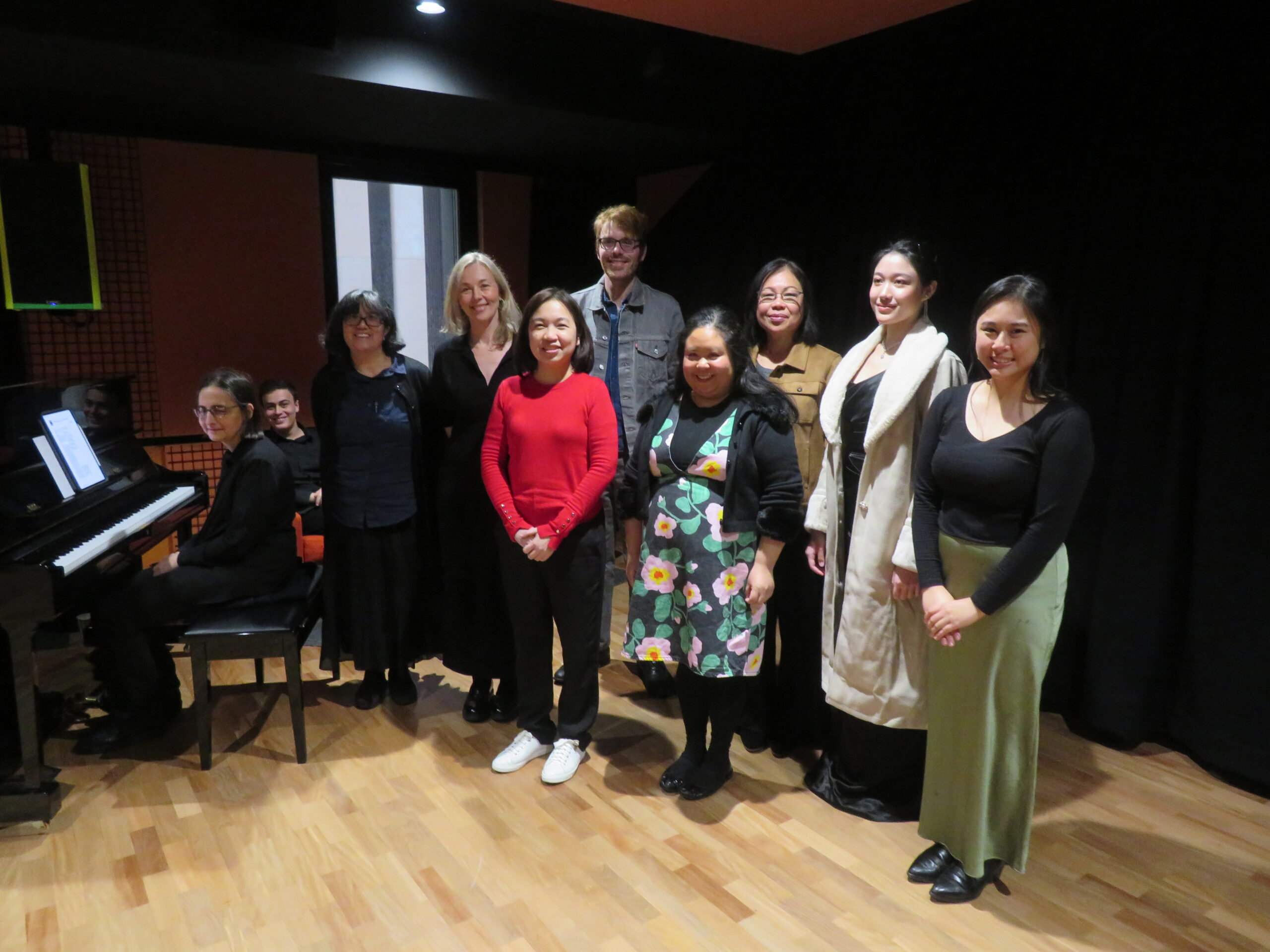
Nancy performing at our Studio Concert
Here are some speech exercises that can improve your singing:
Get those articulators moving
Your articulators play a large part in easy, healthy, resonant speech, which then benefits your singing. Try these exercises that use consonant in drills paired with different vowels to improve how you use your articulators.
- Say Nee, Nah, Noo, Noh, Nair, Naw.
Then try Gee, Gah using a hard ‘g’ as in ‘goat’, rotating around the vowels to help relax the tongue forward and develop resonance.
Now repeat these steps with L, D, T.Add concluding consonants, such as ‘m’:
Nuam, Nem, Neem, Nawm, Nairm, Noom.
This helps coordinate the use of the tongue and lips.
Try these tongue twisters
To build more strength and flexibility in the tongue tip and back, try this:
- Relax the front/tip of the tongue at the front of the bottom teeth, then lift the back of the tongue for the hard ‘g’ sounds: Ghen, Ghan, Ghon, Gawn, Ghin.
This develops the use of more parts of the tongue.
With 22 muscles in the tongue, there are endless ways to gain sensitivity in sounds and songs, and to vary the pace of a phrase, the loudness, quietness and even silence.
In speech exercises, we can also include a tactile component:
- Place your index fingertip sideways between your front teeth – your fingernail should be on one side. Repeat the word ‘knee’, trying to keep your tongue tip gently touching the fingertip, but without biting on the finger sides. Check you don’t have bite marks on your fingers, then repeat. Your tongue is learning to be active and stay forward. Your jaw is learning to relax and do less.
While these drills might seem monotonous, you need to stay aware of the articulator movements, and the changes in voice quality you achieve with repetition.
We don’t speak with one set of vocal folds and sing with another, so working on your spoken voice makes sense if you want to sing with a clear, supported quality. And it works both ways. Learning to relax your articulators and whole body will help you sing. While working on your posture, breath support, shaping the voice channel (lips, facial muscles, jaw, tongue, mouth and throat), will build fluency, pace and pause in your speaking.
As Christina Shewell, speech therapist and senior voice coach at prestigious London actor training centres, says: “If a voice is free, it can do so much – soar, croak, whisper, shout, squeak, growl, and talk without tiring, weakening or straining.”
Your voice deserves to be heard. And voice training with Kathleen Connell can help you sing, and speak, with greater ease and confidence.
Our flexible range of Studio singing lessons will suit your schedule. Call 0402 409 106 to find out more. And get more singing tips in our monthly newsletter.