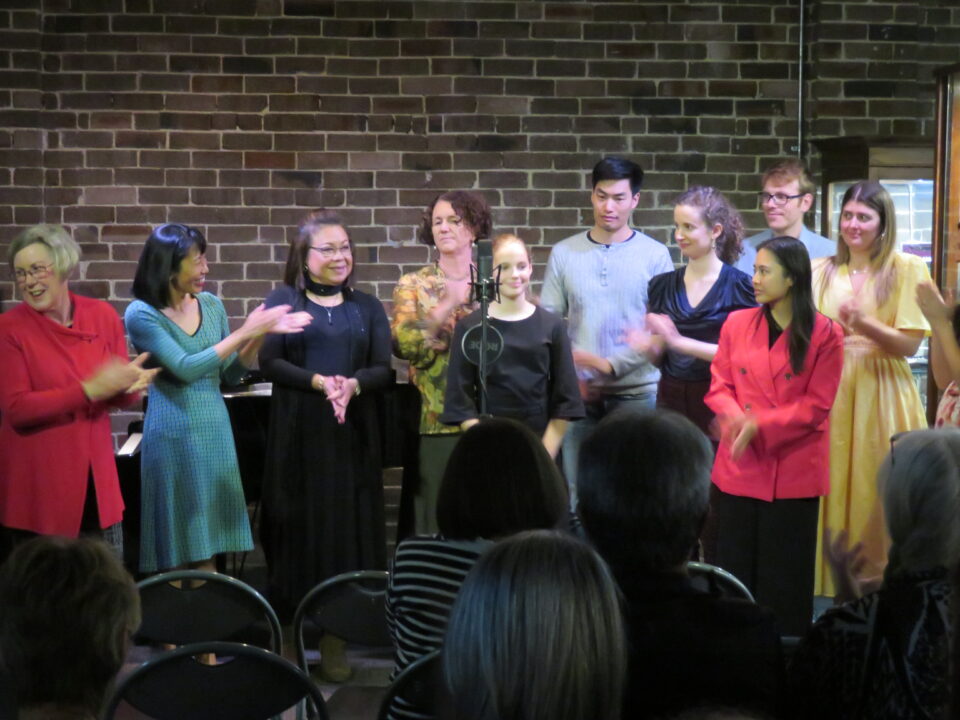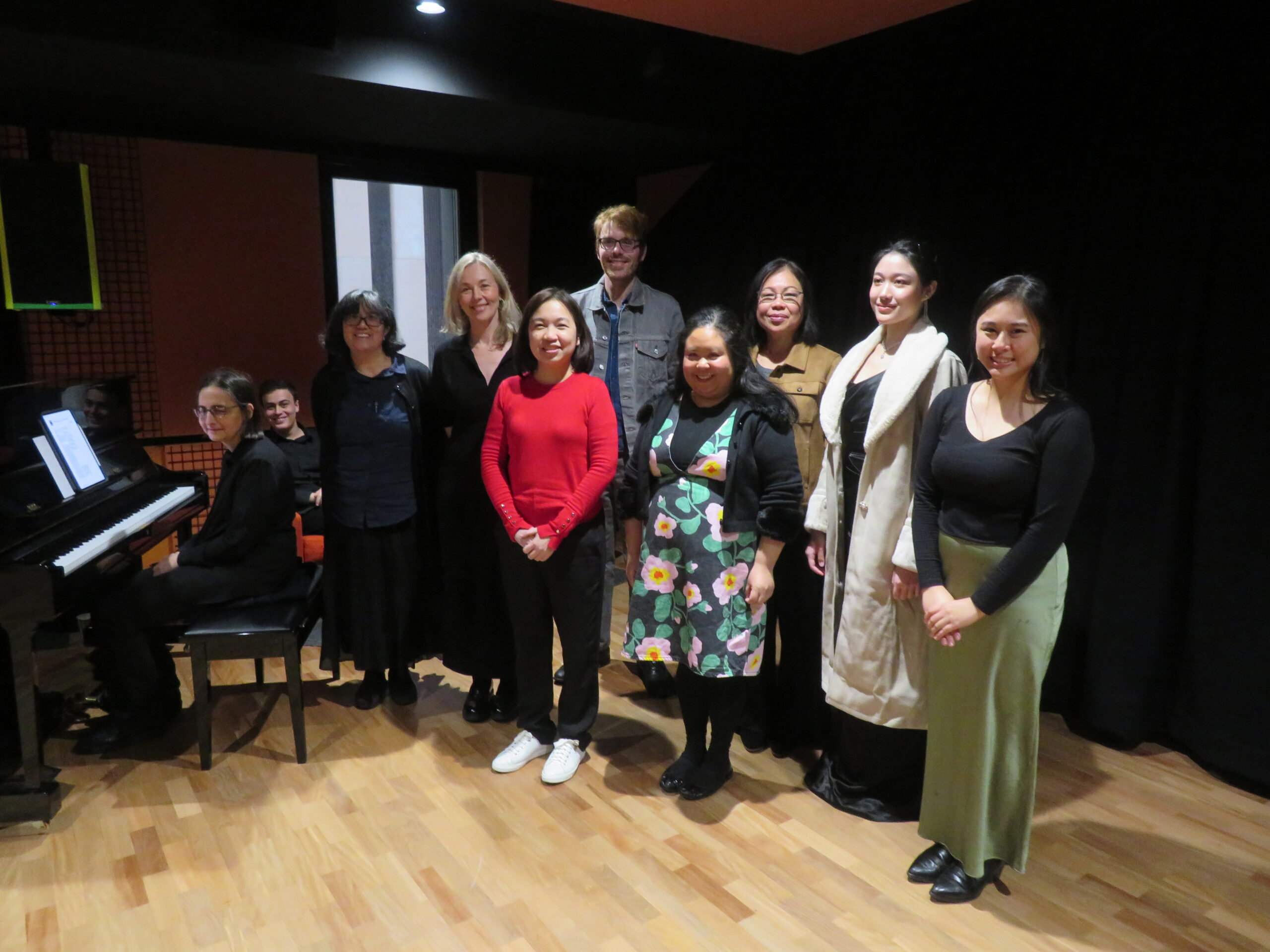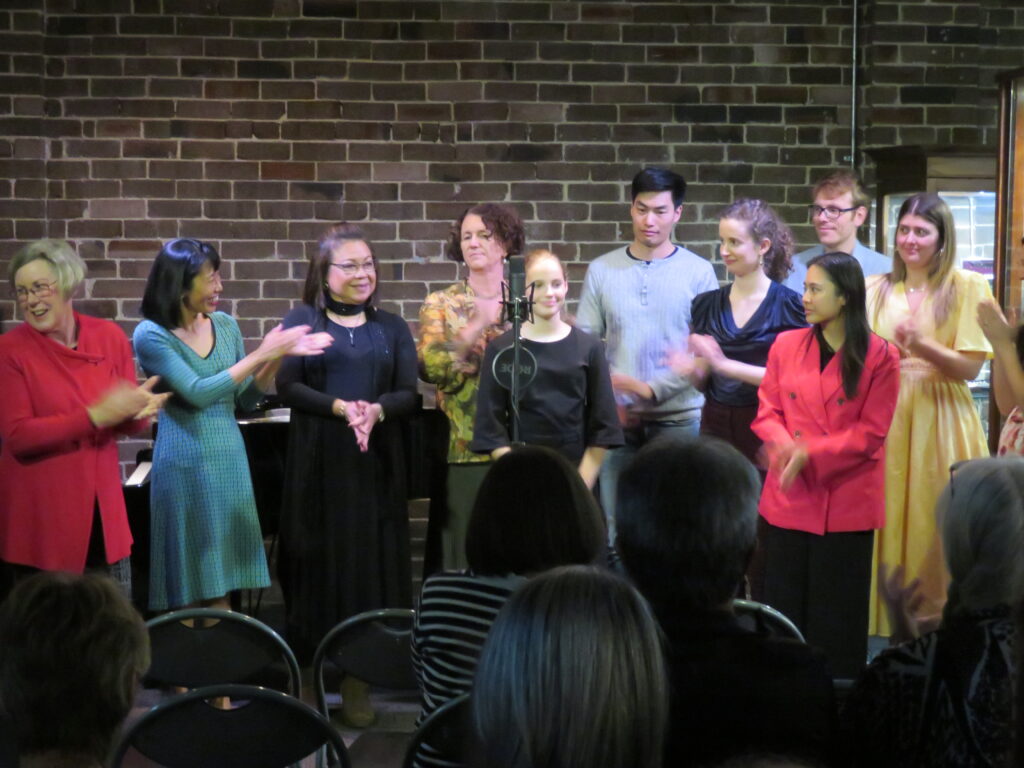
To embody a song’s character, you need to know their motivation. Our acting workshop explored how
The singing workshops and concerts we offer outside of personalised voice lessons are popular with singers, helping them develop their performance craft and confidence. And after a fun first acting workshop late last year, we held our second in May.
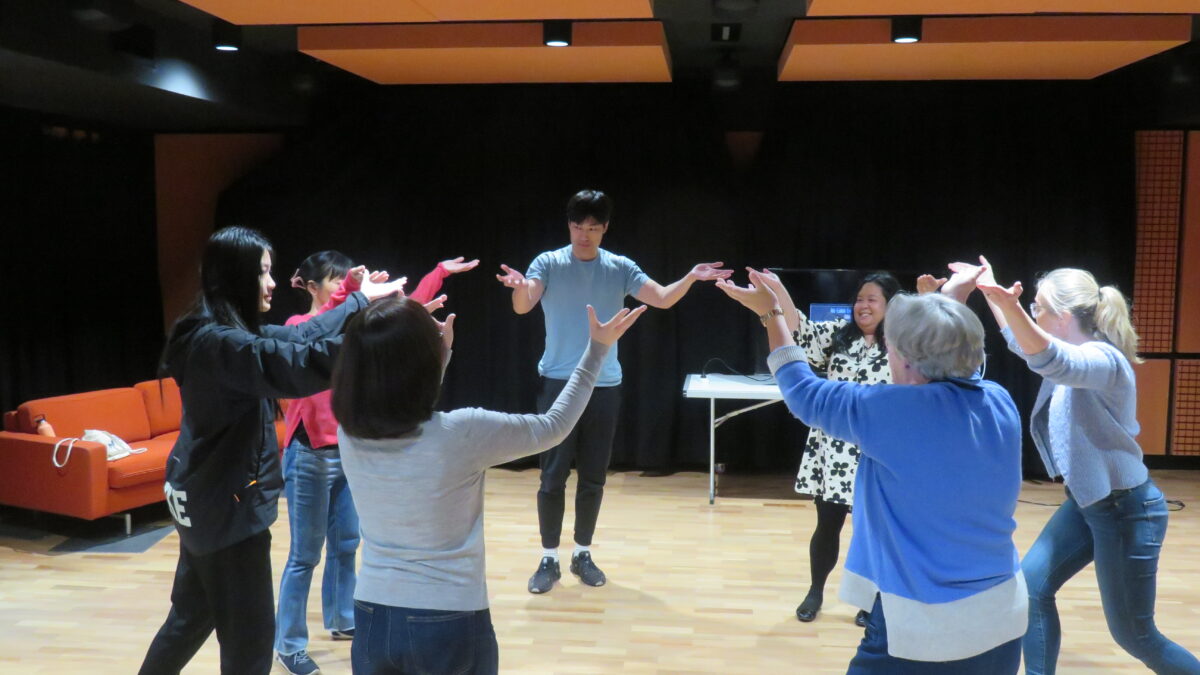
Studio singer and actor-playwright-director, Gina, once again led singers through some warm-up games to build stage awareness and learn how to physically use a space. The game ‘pass the clap’ focused on stage awareness. Singers quickly passed a clap from one person to another. Sometimes in a circle, then more randomly. The idea is to keep your eyes and attention on where the clap is going, so you catch it when it’s sent to you, then quickly pass it to another person. Each round gets faster, so you can’t lose attention.
To help singers bond and cooperate, they worked together as a group to lift an imaginary large glass plate from the floor and keep it level. This activity required nuanced physical attention to each other, keeping one eye on our level and an eye on the rest of the group, with the shared goal of keeping the plate level. Singers had to allow for the varied heights of others, the slowness of the act, spatial awareness and internal balance.
Songs are short stories, needing tension and resolution
Singing in performance is as much about embodying a character and storytelling as showcasing vocal skill. You need to decide who your character is, and identify the stakes in a song and what your character has to do to succeed.
Songs are short stories, so they need tension and resolution. To do this, Gina helped each singer decide on their character’s objective and create a strategy to fight for their goal to achieve it.
For Celine Cheng’s song, ‘You Don’t Have to Say You Love Me’, Gina asked another singer to stand with his back to Celine, whose objective as she sang was to make him turn around. Gina reminded singers that even if you are on your own for a song, you still need someone, even yourself, to sing the song to, and to have an objective in that self-reflection.
Jonathan Lim sang ‘Giants in The Sky’ (Sondheim), and Gina suggested that instead of being the frightened boy character, he would frighten others with his discoveries – similar to when you told scary stories with friends as a child, each one making their story bigger and more ridiculous.
High stakes songs demand strong characters
All music theatre works have an ‘I want’ song, with high stakes for the singer. For Victoria Du’s song ‘Art Is Calling for Me’ (V. Herbert) from The Enchantress operetta, Gina encouraged her to imagine competing with others in an audition but to be more precocious and meaner than the original character. Gina asked three singers to play the other auditionees. Victoria’s objective was to win at all costs and intimidate her competitors as they waited for their audition. She had to find her mean side to the fight for her objective.
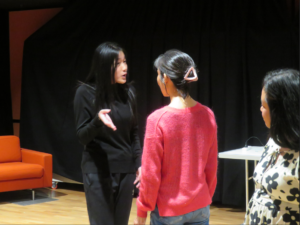
Victoria convincing singers she will win the audition
“I used to think when I’m singing, I’m presenting to an audience,” Victoria said. “Through this workshop, I learned to think ‘What’s the objective for me?’ To think of a goal in a song and try hard for it. That helped me focus less on presenting to the audience, and imagine them as fellow auditionees who I’m competing with in the song. I haven’t acted before, so it was a good experience for me.”
Celeste Del Rosario sang ‘I Could Have Danced All Night’ with such exuberance it ignited Gina’s thinking. She asked Celeste to imagine she was a drunk in a bar. Two other singers played patrons who’d had enough of her excited re-telling of her night at a classy dance. But Celeste’s inebriated young character was determined to tell her story. So much so, a bouncer had to remove her from the bar. This was an energetic, exciting performance of My Fair Lady’s iconic song.
“I forgot about singing the song and just had great fun performing,” Celeste said. “And I realised I’m not actually alone when I’m singing – there’s always someone to direct the song toward, whether it’s the audience or an imagined person in the story. Keeping my attention on them helps quiet the self-consciousness that usually creeps in.”
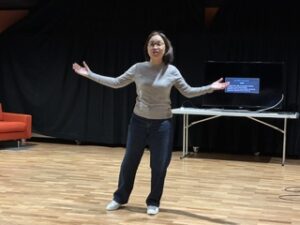
Celeste performing I Could Have Danced All Night. 2026
Claudette Palomares described her song, ‘Mister Snow’ (Rodgers and Hammerstein), as a girls’ gossip moment. So, Gina suggested singing it while doing a boring task: moving papers from one chair to another, but with a twist. Another singer immediately put the papers back on the first chair. Irked by this, Claudette gave the song a sense of pressing forward to create the world she envisages when married to Mister Snow.
“Focusing on a relatively inane action helped distract me from getting too caught up in the technicalities of the singing during performance,” Claudette said. “Gina helped us build purposeful storytelling, which is critical to a great performance. Some songs are really clear in their motivation, others are more vague. Pinpointing the ‘want’ reveals a song’s emotional territory and helps you convey this to the audience.”
There’s more to singing than vocal prowess. With years of experience teaching the science of singing and the art of performance, Kathleen Connell helps singers take their craft to the next level.
Browse our flexible range of Studio singing lessons. Call 0402 409 106 to find out more. And get more singing tips in our monthly newsletter.