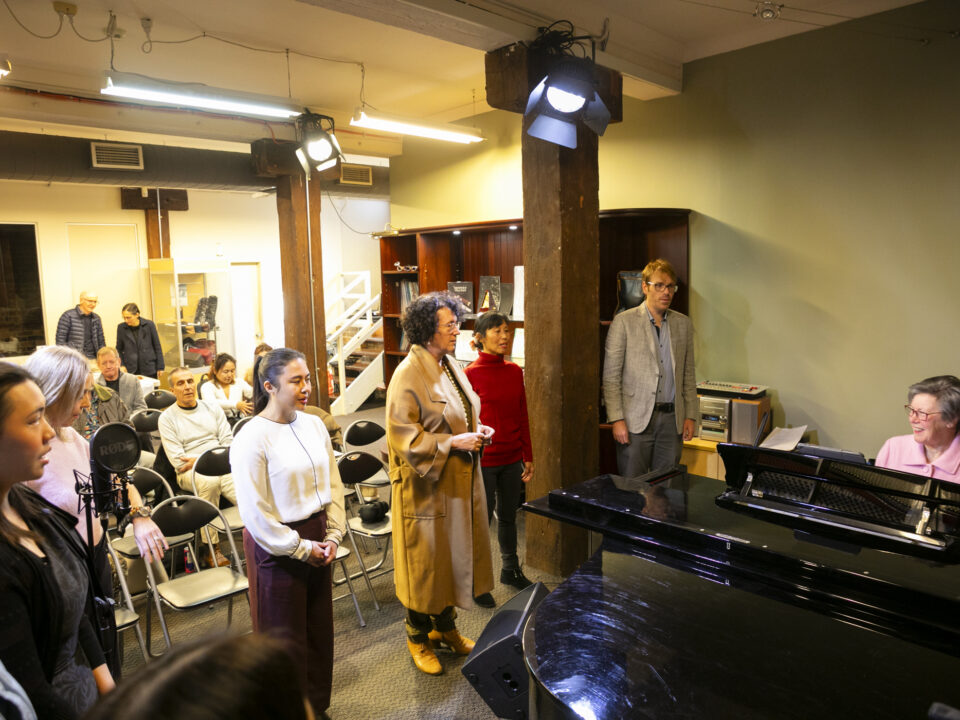
A loose tongue is an asset in singing. Here’s how to free up yours

Wherever you’re at in your singing training, the foundations of posture, breathing and articulation are something you’re always working on. This is because your body’s alignment is closely linked to singing ease, balanced breathing, and the complex use of the tongue. Without this balance, one part will be more dominant or tense, making singing uncomfortable. And unlike an instrument such as piano or guitar, your vocal instrument – including your body – can change from day to day.
The science of voice use is always changing too and, while I’ve written about the tongue in singing before, now we’ll do a deeper dive based on new research I learned in a recent webinar.
Your tongue is like a national park
This fun analogy comes from the webinar, based on singer and voice researcher, Dr Angelika Nair’s book, The Tongue as a Gateway to Voice, Resonance, Style and Intelligibility (2021: Plural Publishing). I think it’s an apt way to consider the tongue’s anatomy and function. It has valleys, mountains, cliffs, plains, and can move internally and externally.
Ultrasound mapping of tongue movements shows it can be depressed, pulled forward, sideways. It can curl, squeeze and pull back and forward. It can flip up and down at the front tip, and parts can be used separately from the whole. That’s only some of its movements! Suffice to say, your tongue is a complex, acrobatic part of your anatomy, always moving whether you’re awake or asleep, and its main function is not speech and song, but swallowing.
Your tongue’s anatomy
The tongue’s basic parts are the root, body and tip. It is attached to other parts of your mouth including the jaw (by the tiny hyoid bone), the tonsils, epiglottis and pharynx. It is meshed with ten interior and exterior muscles. Your tongue is about 16 centimetres long, if pulled out completely, including the large root which we can’t see.
The tongue fills two-thirds of the vocal tract, which begins at the top of your larynx and comes up through your throat, then bends around into your mouth area. Within and around the mouth area are the major articulators: soft and hard palate, teeth, jaw, lips and tongue.
At the roof of your mouth the palatoglossus, part of the soft palate, connects to the sides of your tongue. When singing, if you don’t actively raise your soft palate your tonal colour will sound nasal, narrow and pinched. Singing training help singers learn how to raise the soft palate and keep it open. Without it, the entire system collapses and resonance will be lost.
Permission to poke out your tongue: 2 exercises
You may have been told, as a child, not to stick out your tongue. With these two exercises you have full permission!
The Lion

Photo from Unsplash by Pedro Miguel
- Stretch or poke your tongue fully out. Turn the tip down to the chin and wet it. Feel the stretch on your tongue, particularly the root.
- Try it again.
- Then with a big fairy tale voice say “HELLO, MY NAME IS…” Don’t forget to breathe.
The tongue is the only muscle in your body that can contract (shorten) and expand (lengthen and release) at the same time. It can contract back towards your throat while stretching forwards towards your teeth.
Tongue stretch
- Take a towel, hold your tongue with the towel and gently pull it out.
- Hold for 5 seconds.
- Gently pull it to the left then the right. Release it.
- Sing a short exercise, using La, Li, Ki, Ka, Mai, say on five notes up and down.
- Repeat two to three times. Notice any difference? Things like more space in your throat and mouth, freer tongue movements.
Exercise
- Take the bulk of your tongue to the back of your mouth. Doing this makes the tip drop down behind the bottom teeth.
- Say the numbers 1-10, days of the week, or months of the year.
- Now, bring your tongue very forward in your mouth. The tip could stay behind the bottom teeth as the bulk of the tongue curls forward. If it pokes out, that’s fine. And if saliva forms, keep a tissue handy.
- Say days of the week, 1-10, or months of the year.
- Let your tongue find a ‘middle’ space. Again, say the days of the week, months of the year and 1-10. Notice how precise, free and easy it feels.
- Sit in front of a mirror and see how normal it looks to articulate clearly and precisely.
Concerned about consonants?
How do you open your throat, and keep it open for resonant tone, while using your tongue to sound clean, crisp consonants? Will you have to close the space and lose the resonance?
No. Singing training helps you balance the transition between consonants and vowels, while keeping the throat open. Learning this skill feels weird at first, because we’re used to fast everyday speech, which mostly uses the front of your oral cavity with little awareness of the bigger space at the back.
Exercise
- Say Li and La and Ki and Ka. For Li and La, the tip of the tongue is active behind your top teeth. For Ki and Ka, the middle back of the tongue moves up to the mouth roof.
- First, just notice how your tongue moves. Which part is working, and which seems easy and without tension?
- Say it again, noticing your tongue’s moves. Is it easier now, or is there still unnecessary tension?
- On a five-note scale up or down, sing: La, li, la, li, la and Ki, ka, ki, ka, ki. Sing these in a legato, or smooth and connected manner.
- Notice the moves between the consonants and vowels. Is the air flow connected?
- Try again and notice if your tongue moves more freely, and the air flow is connected.
- Try different sounds. Sometimes I use the names of outback Australian towns. Use simple musical patterns:
- Boggabilla
- Dooroonari
- Goondawindi
- Chookachilla
Notice how the tongue and adjoining articulators move, rather than making an internal commentary on your sound.
Whether you’re singing popular songs, compelling music theatre or classical arias, or songs that require a more formal use of English and European languages, learning how your major articulators bring intelligibility, sleek stylistic approaches and emotional connection to the songs you love, is an essential and impactful skill.
If a tight tongue is holding back your singing, Kathleen Connell can help you free it up for a more open sound.
Browse the in-person or online training options, or call 0402 409 106.