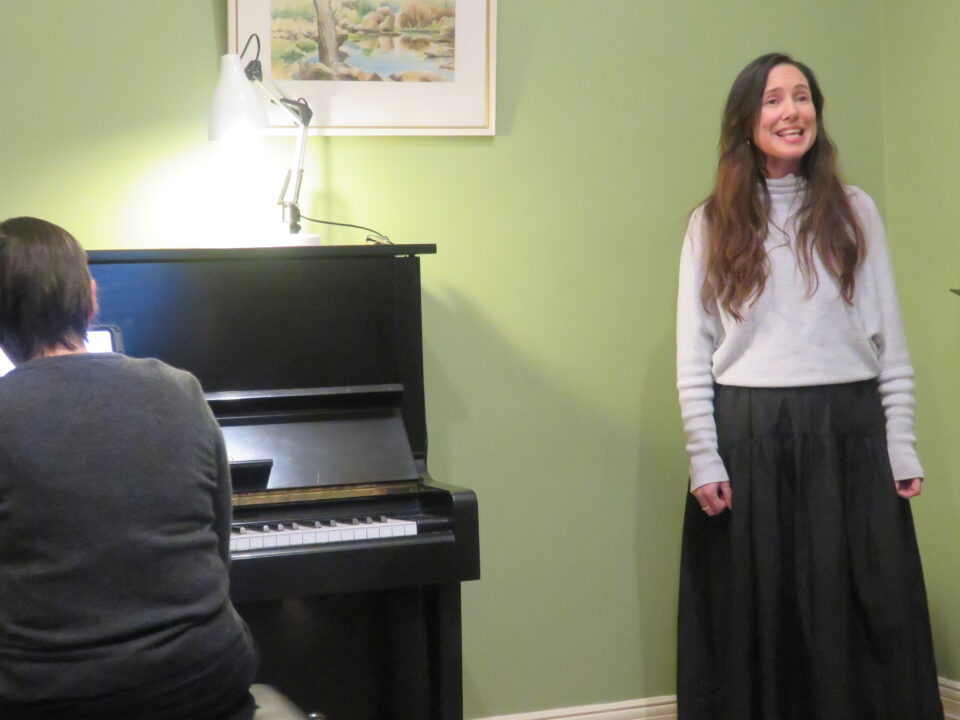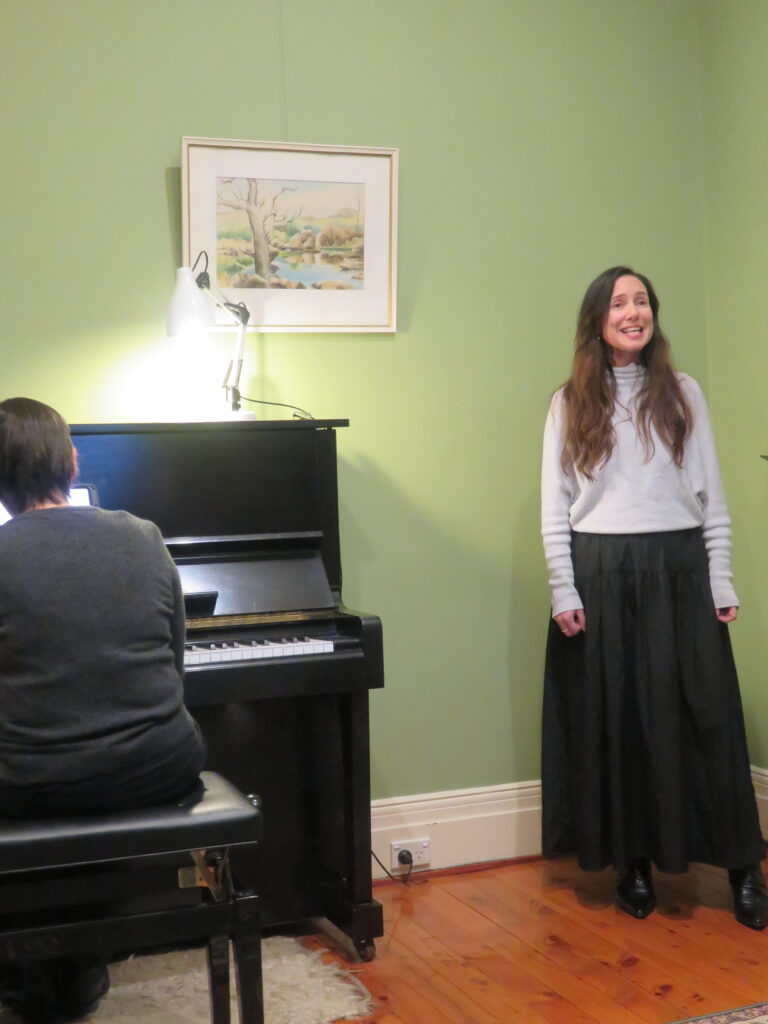
Whether you’re a beginner singer or you have more singing experience, you’d know that healthy, sustainable vocal production requires head to toe engagement and supportive posture. Your body’s pelvic area plays an important role here, but it’s not often given attention in singing training.
In our series of articles on breathing for singing, we’ve looked at inhalation, exhalation and now, we’ll look at how to use your pelvic floor for breath control in singing.
I recently discussed this with student Rena Elise ElKhoury and you can watch our talk below:
Why is the pelvic floor important for singing?
The goal of engaging your lower abdominal and pelvic muscles to support and control your breath is to make singing free and efficient. You need enough breath to get through phrases in songs, and to be a more versatile singer.
When you breathe into your lower abdominal area, you will notice a slight bulge in your rectus abdominus muscle (AKA ‘six-pack’). This is a sign your inhalation is working well.
Your abs and pelvic muscles are important on the exhale, to control the air flow that allows you to sing with the energy and volume your song requires.
And it’s specifically the rectus abdominus muscle that singers learn to gently, consciously compress during exhalation. This action needs to be coordinated with keeping your rib cage expanded from inhalation, so that you release air from your low belly first, then from your ribs. This is what gives you the slow, controlled air flow you need to sing. It can be a tricky sequence to learn, but essential to maintain air flow, rather than squeezing or overusing muscles near your larynx and vocal cords.
Try these breathing exercises to engage your pelvic muscles
- Place one hand, with fingers spread, above your belly button.
- Place your other hand, fingers spread, below your belly button.
- Take a slow, deep breath low into your belly, then exhale on a ‘sssshhhh’ sound for several seconds. Engage the muscles of your entire belly wall, top and lower, as you would for sit-ups. Repeat.

- Next: Place one hand below your belly button, do some short, strong ‘sshhh’ sounds. This isolates and engages the lower belly wall.
- Take another low breath and notice a bulge or bulking feeling at your mid or upper belly wall, as if an umbrella has opened in your mid-section – that’s your ribs opening. Now try isolating and squeezing the low belly muscles on an out breath, while keeping the upper belly wall open. Gradually on a slow out breath, the umbrella will fold down.
- Notice and feel the difference between using your entire rectus abdominis and different sections of your belly wall.
Pro tips
- Instead of sucking in large amounts of air, practise fully releasing your belly muscles to ‘invite’ breath in.
- You don’t have to exhale all the air in your body before inhaling again. When you sing, you only move out enough air for the phrase.
- Instead of thinking note to note, think about where the entire phrase is going. Thinking about each note makes the music stiff and stilted. Think about where you are going on your inhalation and the air and music will flow.
Learning to coordinate your inhalation and exhalation takes time, as you notice how engaging certain abdominal muscles makes singing easier. With practice, and a voice coach who understands how to adapt singing techniques to suit your body, you’ll fine tune the pressure of air flow and volume, to sing continuously over a phrase, give your voice a fuller and clearer sound.
Find the best way to use your body to sing with guidance from experienced singing teacher, Kathleen Connell. Browse the studio’s in-person or online singing lessons, tailored to your specific needs. Or call us on 0402 409 106.