During singing practice, singers may focus too much on the outcome:
Did I sound great, like my favourite singer?
Was I in tune?
Did I make it to the end of the phrase?
Understandably, you just want to get it right. But when you practise, it’s helpful to focus less on outcomes and expectations, and more on approaching practice with a strategic mental process, or plan, as you do with your singing teacher in lessons. Over two articles, we’ll look at this concept of a mental process in more detail.
Focus not only on your technique, but on your mental process
For singers in our lessons, I will often break up challenging sections of a song, or the process of teaching them a new skill, into smaller, targeted goals. And I often ask them what skill they want to implement as they practise an exercise, vocalise or song.
You might choose to focus on posture, breath flow, or resonance, but you need to decide on one. Then, as you sing an exercise, a song or part thereof, you monitor the steps, and the thinking, involved in that particular process. Afterwards, I will ask: “How did that go? What did you discover? Was there anything you would change or adjust?”
This mental process of focus, notice and reflect helps you hone the skills you’re developing. In lessons, I will encourage you to use this deliberate focus. But when you go home to practise, you might find it unpredictable and frustrating. Time to think like your singing teacher!
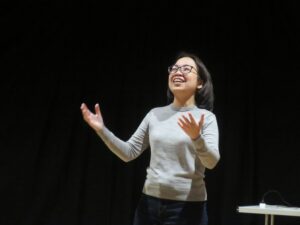
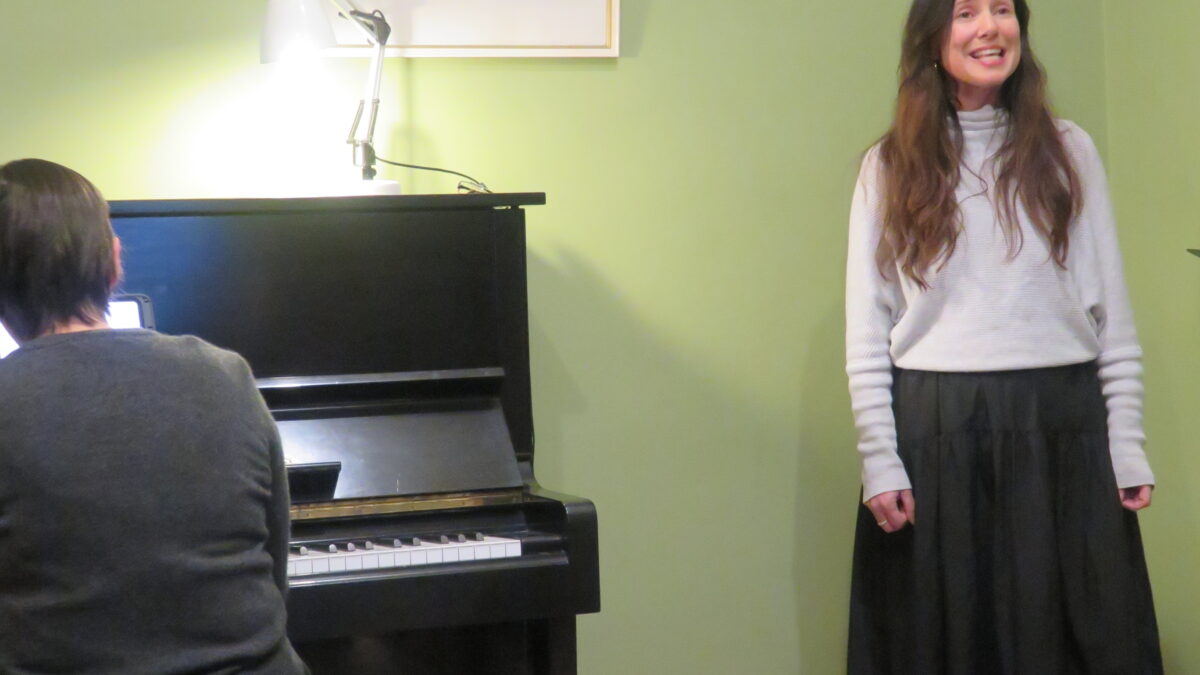
Celeste performing I Could Have Danced All Night
Part of being your own teacher during practice is to pay attention to what you do and feel when you sing; and to reflect on each action with questions and answers:
Why wasn’t what I did quite successful? Oops! I forgot to set up my breath.
Why did it work? My plan to focus on an open throat was there and I sounded free – Great! But other factors need attention.
Staying positive and non-judgemental is key. Acknowledge your successes, and plan what adjustments you’ll make to fix any issues you’ve identified, such as:
I ran out of breath on that phrase. Next time, I’ll set up my breath, and monitor my ribs’ and abdominals’ expansion and contraction, to control breath flow as I sing.
Repetition uses motor learning and memory to embed new skills
As we explored in the August and September articles, your brain builds a working memory of actions, movements and sensations. This five-minute TED-Ed video neatly explains how practice affects the brain, and how to maximise your time effectively:
- Focus on the task at hand.
- Minimise distractions.
- Quality repetitions build coordination.
- Limited duration of practice.
- Imagination can reinforce quality habits.
We draw on these learnt behaviours when we practise, and then combine the felt body senses and sound to create singing. One goal of singing practice is to replicate the feelings we worked on in lessons. So, it’s helpful to ask yourself:
Where are the feelings located?
How does my body move?
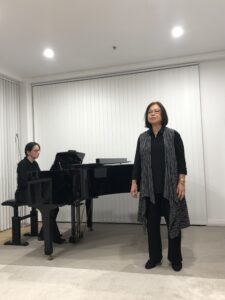
Anne and Alison Rehearsal June 2025
If a technical skill or section of a song troubles you, stop and slowly breathe in and out four times, making your out breath longer – this helps calm you. Write down the problem and categorise it. For example: blending registers, interval accuracy, articulation. Accept there will be mistakes and create a strategy for dealing with them. Keep an open mind, and allow yourself the courage to push further into strengthening your singing skills and out of the comfy ‘doing what you know’.
Not enough time? Use the time you have
Instead of feeling frustrated that you don’t have any time for your singing practice, harness the power of frequency. Try little and often, focussed and specific. A little practice every day is less stressful than cramming it in. And the discipline of showing up for practice creates a healthy habit you can keep up. Ultimately you are your best teacher.
In part 2, I’ll include some practice tips that use this mental process approach.
Learning to sing requires clear processes, and those processes need deliberate skills.
Kathleen Connell teaches you those skills, which you can put into practice with your own guidance. Find a singing lesson package to suit you.